
Glass Clean-Up — crystal-clear views again
From safely clearing a shattered pane to deep-cleaning years of coastal film off your sliders and storefront glass, we restore the clear view and curb appeal your property had on day one.
Why does coastal glass look hazy even after you clean it?
A wall of sliding glass is the centerpiece of most Florida homes — and the first thing to look tired. Salt air leaves a permanent-seeming haze, sprinklers etch hard-water spots, and construction or a broken pane can leave glass fragments everywhere glass should never be.
Dirty or damaged glass doesn't just look bad. Film and mineral deposits are mildly corrosive and slowly damage the glass surface if left in place, and impaired visibility through a full-height slider is a genuine walk-into-it safety hazard — for guests, kids, and birds alike.
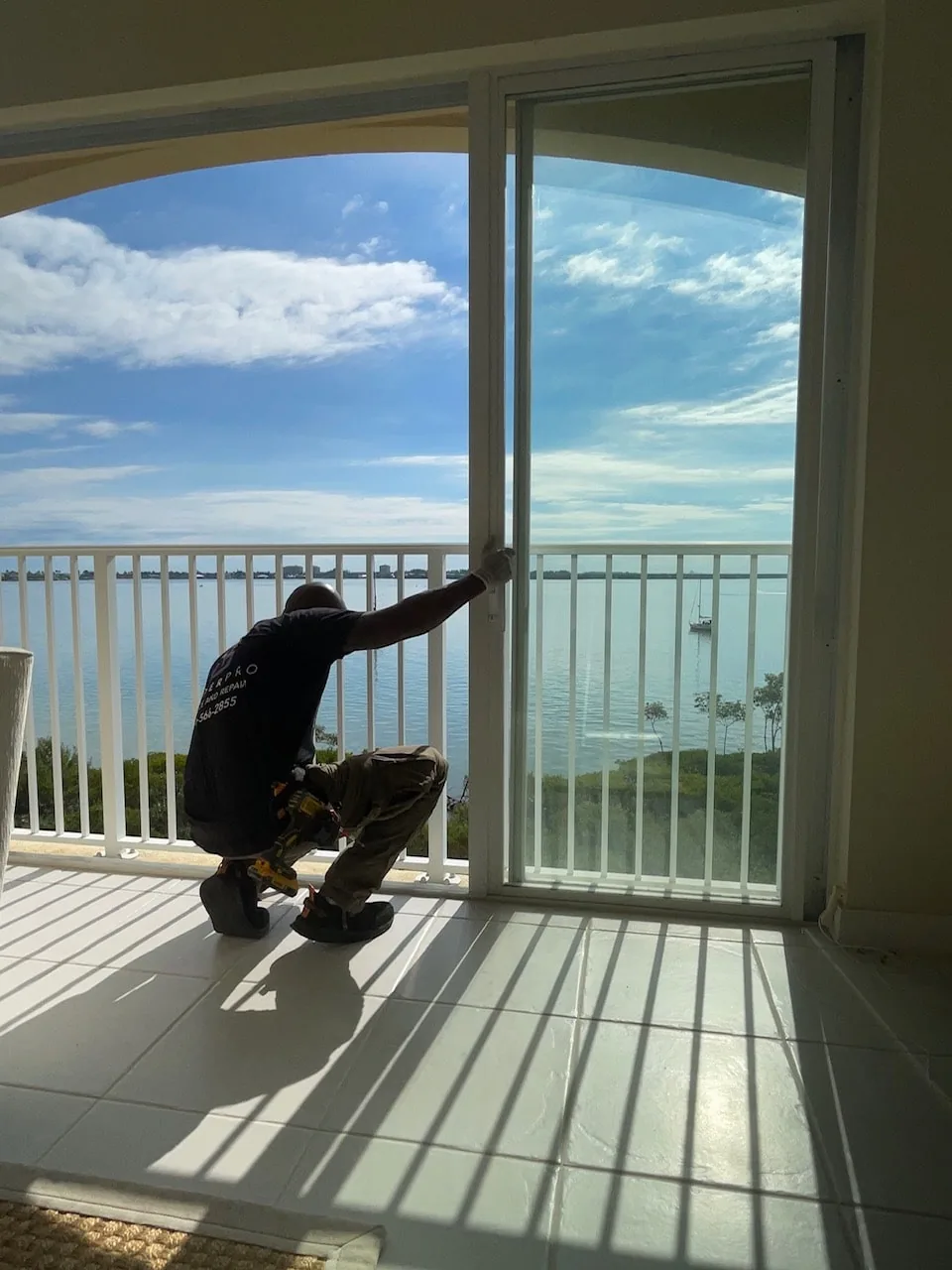
SliderPro's clean-up service covers residential and commercial properties across the Treasure Coast: sliding doors, windows, and storefront glass, restored with professional techniques and quality solutions.
What happens on a glass clean-up visit, step by step?
Assessment & preparation
We evaluate the buildup or breakage, protect the surrounding area, and flag any special requirements.
Specialized cleaning
Eco-friendly, non-abrasive agents dissolve dirt, salt film, and mineral deposits without harming coatings.
Detailing & inspection
Edges, corners, and frames are detailed and the glass inspected for a streak-free result.
Protective finish
A protective treatment helps repel future dirt and spotting, keeping the shine longer between cleans.
What does a professional glass clean-up actually change?
- Visual enhancement — sparkling glass lifts the look of the entire property.
- More natural light — clean panes noticeably brighten interior spaces.
- Preventive protection — removing corrosive residue extends the life of the glass itself.
- Safety — full clean-up after breakage, and clear sightlines through every pane.
Glass questions Treasure Coast homeowners ask us
What does the Glass Clean-Up service include?
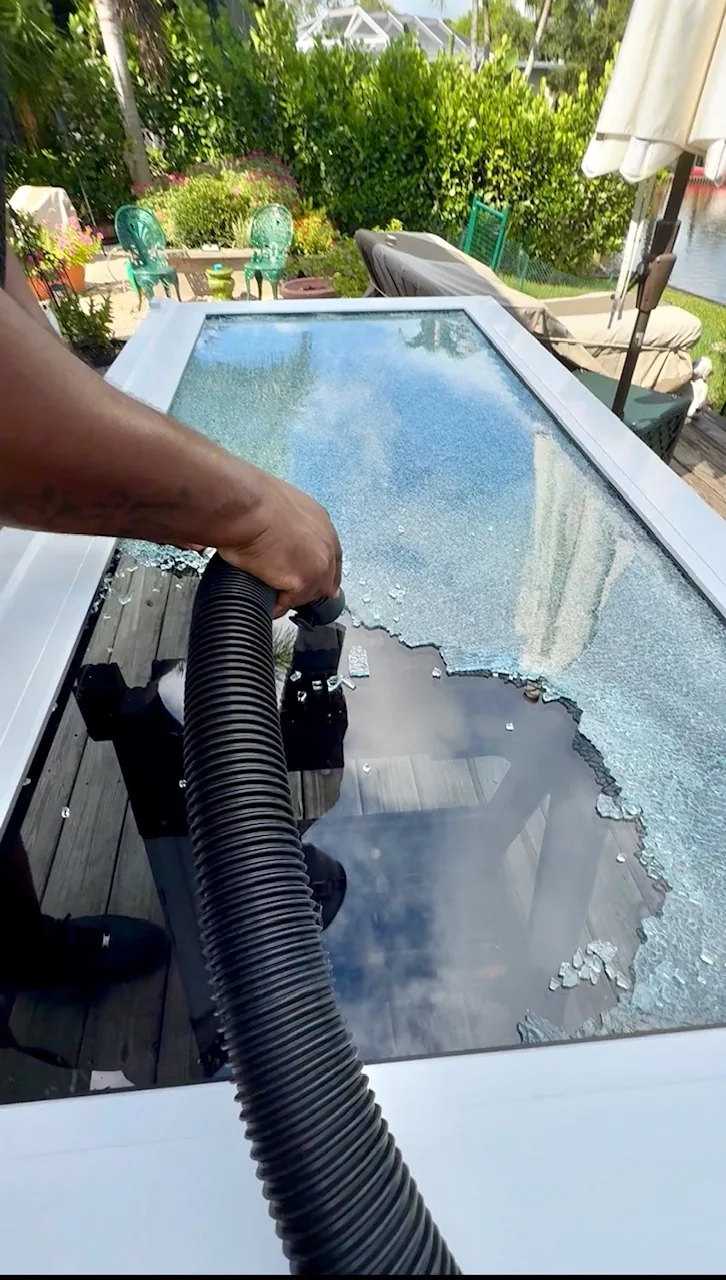
Two things, depending on what you need: safe removal and clean-up after a broken or shattered pane, and professional deep cleaning of glass that's clouded with salt film, hard-water spots, and mineral deposits. Either way, the goal is the same — your property looks great again, as if nothing ever happened.
Why does my glass look permanently hazy even after I clean it?
Coastal air deposits a fine salt and mineral film that ordinary glass cleaner smears around rather than removes. Sprinkler overspray adds hard-water spotting on top. We use specialized, non-abrasive cleaning agents that dissolve those deposits without scratching the glass, then finish with a protective treatment that helps repel new buildup.
A pane in my slider shattered — can you handle the mess?
Yes. Tempered glass breaks into thousands of pieces that spread much further than people expect, indoors and out. We remove the broken panel, clear the glass safely from tracks, frames, carpet edges, and landscaping, and leave the opening secured and tidy.
Is the cleaning safe for tinted or coated glass?
Yes — our products are eco-friendly and non-abrasive, chosen to be effective on grime while staying gentle on tints, low-E coatings, and seals. That balance is exactly why we don't use the harsh acid washes some crews rely on.
Your pane just shattered. What should you do in the next hour?
If a sliding door pane has just gone, the first hour matters more for safety than for the door.
- Get people and pets out of the room, then keep them out. Tempered fragments travel much further than anyone expects, and they are worst in the places nobody looks: under furniture, along the carpet edge, in the pile of a rug and on a pool deck where people walk barefoot.
- Do not clear it in bare feet or flip-flops. Closed shoes and heavy gloves, and do not sweep with a soft broom, which pushes fragments deeper into carpet and grout instead of lifting them.
- Leave the panel where it is if it is still standing. A pane that has fractured but is still held in the frame is under no useful tension and can drop the rest of the way when moved. Do not try to lift the panel out.
- Photograph it before anything is touched. Wide shot, close shot, and the frame and track. That record costs nothing and is useful to an association or an insurer later. We are not insurance advisors, and what you do with it is between you and them.
- Check the track and the sill before you close anything. Fragments sitting in the track will get dragged along it and score the rail.
Then call us on 772-722-4036 and say plainly that it is a broken pane rather than a repair, so it gets scheduled as one. Ask on that call what we can do about the opening itself. The answer depends on the door and the situation, and we would rather tell you on the phone than make a promise on a web page.
How does tempered glass actually break, and where do the pieces end up?
Nearly every sliding door pane in Florida is tempered, and tempered glass fails in a way that surprises people the first time they see it.
Tempering means the glass was heated and then cooled fast at the surfaces. The outer skin sets first and ends up in compression, while the core cools afterwards and ends up in tension. That locked-in stress is what makes the pane four to five times stronger than ordinary glass, and it is also stored energy. Break the compressed skin anywhere and the whole balance collapses. Fractures run through the entire pane in milliseconds and it comes apart into thousands of small cubes rather than long shards. That is deliberate, and it is why tempered glass is safer despite the mess.
It also explains the breakage that seems to happen for no reason. Three causes account for most of them. A chip or nick on the edge of the pane, often done during installation years earlier, sits in the compressed skin and eventually propagates. A microscopic nickel sulfide inclusion left in the glass at manufacture can slowly change volume and burst the pane from inside, sometimes years later. And thermal stress, where one part of the panel bakes in afternoon sun while another sits in deep shade, loads the edge until something gives.
The practical consequence is where the pieces go. Cubes bounce. We routinely find them fifteen and twenty feet from the opening, in landscaping beds, in the pool skimmer, inside the track, under the sofa and in the weep holes at the bottom of the frame. A single sweep of the obvious area is never the whole job.
Clearing the glass: tracks, weep holes, carpet edges, pool deck and landscaping
Clearing a broken pane properly is a search pattern rather than a sweep, and it follows where the fragments actually travel.
- The track and the sill. First priority, because anything left in the rail gets dragged along it by the remaining panel and scores a groove the rollers then have to ride over. This is how a broken pane turns into a roller job six months later.
- The weep holes. The small slots at the bottom of the frame that let rainwater out. Glass cubes wedge in them beautifully, and a blocked weep hole means water backs up in the sill and finds the inside of your floor during the next heavy afternoon storm. Anyone who clears the glass and not the weeps has left you a leak.
- Carpet edges and rug pile. Fragments work down into the pile and out of sight, then surface weeks later under a bare foot.
- The pool deck and the pool itself. Cubes on a wet deck are almost invisible, and anything that has reached the water needs the skimmer and the floor checked, not just the surface.
- Landscaping and mulch beds. Mulch swallows glass and gives it back at the next weeding.
- Furniture, cushions and the dog's bed. Anything soft within throwing distance.
We work that list in order and finish with the frame and track cleaned out, because the door still has to slide when this is over. If the remaining panel has been running on debris, it is worth checking the rollers at the same time rather than discovering the damage later.
Fogged, hazy or cloudy? Three different problems, three different fixes
People use the same three words for three unrelated faults, and only one of them is a cleaning job.
Fog between the panes is a failed seal, and it cannot be cleaned. An insulated unit is two sheets of glass bonded to a spacer filled with desiccant. Years of UV, thermal cycling and standing water in the sill degrade the perimeter sealant, the desiccant saturates, and moisture condenses on surfaces that are inside a sealed cavity. Nothing you or we can apply reaches them. Over time the trapped moisture also leaves mineral staining on the inner faces, which is the permanent-looking milky patch in the corner. The fix is a new sealed unit, not a cleaner.
Salt and mineral film sits on the outside, and it does clean off. Coastal air deposits an extremely fine salt aerosol that is hygroscopic, so it holds moisture against the glass and keeps working. Ordinary glass cleaner smears it rather than dissolving it, which is why the pane looks worse ten minutes after you wipe it. Correct products dissolve the deposit instead of moving it, and the pane goes genuinely clear.
Hard-water etching is damage, not dirt. Sprinkler overspray carries dissolved calcium and magnesium. It evaporates on hot glass and leaves an alkaline deposit that slowly attacks the silica surface, leaching sodium out of the glass itself. Early on it lifts with the right treatment. Left for years it becomes microscopic pitting, and pitted glass scatters light no matter what you put on it. The rainbow sheen some owners describe is the tell.
The quick self-test: wet a finger and touch the haze on the inside face, then the outside face. If neither changes the appearance, the problem is between the panes.
Tempered, laminated or impact: what your panel probably is, and why it matters
Before anyone talks about glass, it helps to know which of three things you have, because they behave completely differently when they break and they are not interchangeable.
- Tempered. Heat-treated single-layer safety glass, the default in most Florida sliding doors built before impact requirements applied. It shatters completely into cubes. Look for a small etched stamp in one corner, usually at the bottom.
- Laminated. Two sheets bonded to a plastic interlayer. It cracks but tends to stay in the frame, held by the interlayer, which is why a laminated pane often looks like a spider web rather than a hole.
- Impact rated. A laminated assembly qualified to a specific standard for wind-borne debris, common in doors built after the post-2005 code changes and dramatically heavier than the glass it replaced. That weight is the reason impact doors wear out undersized rollers years earlier than their owners expect.
Three things follow from which one you have. Impact and laminated units in the wind-borne debris region are governed by the Florida Building Code and by permitting rules that vary by county, so your building department, not a repair company, is the right first call on what a replacement has to meet. Impact panels are not something to swap like for like on appearance. And an older tempered panel in a 1970s or 1980s aluminum frame may sit in an extrusion that no current unit is sized for.
We clear the glass, we tell you which of the three you have, and we tell you plainly what the panel needs next. Our guide to choosing a sliding door that survives Florida covers the glass and frame decisions in full if a replacement is on the table.
Condo, HOA and gated-community glass rules before anyone touches the door
In a condominium, the glass in your balcony slider may not be entirely yours, and finding that out after the work is the expensive way.
Florida condominium documents divide a building into the unit, the common elements and the limited common elements, and a balcony slider frequently straddles the line. Declarations commonly split the door itself: the glass treated one way, the frame and track another, the screen another again. It is genuinely normal for an owner to be responsible for the pane while the association owns the frame it sits in, and for the maintenance obligation and the insurance obligation to fall on different parties for the same piece of glass.
Appearance rules stack on top. Because a slider is part of the elevation, associations often mandate the tint, the reflectivity and sometimes the exact product, so a pane chosen for price can fail an architectural review even when it is technically correct.
The order that works: find the maintenance, insurance and alterations clauses in your declaration; ask the manager in writing who is responsible for the glass, the frame and the screen on your specific door; get the answer before you approve anything; and keep the paper trail. Our condo and HOA responsibility guide works through the vocabulary and the five ways owners end up paying twice.
Clearing broken glass is generally urgent enough that safety comes first and paperwork follows. Anything beyond that is worth a phone call to your manager before we arrive.
When you're up north and the glass breaks at home
A seasonal home is where a broken pane does the most damage, because nobody finds it for a while.
The sequence is always the same. A neighbor, a cleaner or a property manager calls with a photograph. The owner is a thousand miles away, cannot see how bad it is, and cannot tell whether it is a safety problem or a nuisance. Meanwhile the opening has been letting weather, insects and wildlife into the house, and afternoon rain has been running into a sill whose weep holes are packed with glass.
What we can do from here is straightforward. We work with property managers, neighbors and cleaners as routine, so an owner does not need to be in the state. Tell us who holds a key and who can let us in, and we will clear the glass, check the track and the weeps, and tell you exactly what the panel needs and what is involved, in writing, so you can make the decision from wherever you are.
The preventable version of this is a close-up check in spring. An empty house is also where doors seize, because hardware corrodes fastest when nothing moves and nothing wipes the salt film off the bearings. The seasonal and rental property checklist sets out the close-up and open-up routine, and a maintenance visit covers every slider in the house in one trip before you fly.
How we quote glass work
Glass calls come in two shapes, and we price them differently because they are different jobs.
A clean-up after breakage is priced on the extent of the scatter, not the size of the pane. A pane that failed inward onto a tiled floor is a contained job. The same pane failing outward across a pool deck, a screen enclosure and two landscaping beds is a much longer one, and any pane that has put fragments into the track and weep holes adds the door work that has to follow.
A deep clean is priced on the number of panels, the height, and which of the three haze problems you actually have. That last one matters most, and it is why we look before we quote: a salt film comes off, early hard-water deposit usually comes off, and a fogged sealed unit will not come off at any price. Quoting a fogged unit as a cleaning job would be taking your money for a result that cannot happen.
Repairs start at $275, including parts, labor and a one-to-three-year warranty on both. You get told what is included and what is not before any work starts, and if the honest answer is that the panel needs something we are not the right people for, you get told that too. Our Florida cost guide covers what a complete estimate should contain.
Where we handle glass, from Port St. Lucie to Palm Beach Gardens
We are based in Port St. Lucie and cover fourteen cities along the Treasure Coast, into Brevard County and inland to Orlando, and into northern Palm Beach County, for homes, condos and commercial properties alike.
Exposure changes what we find. Ocean-facing glass on Hutchinson Island and in Jensen Beach carries a heavier salt load and shows haze years sooner than mainland glass. Inland homes in Palm City and western Port St. Lucie get hard-water spotting from irrigation instead, which is a different problem with a different fix. The wide lanai walls in Palm Beach Gardens and Jupiter simply give the sun more surface to work on.
We also cover Stuart, Port Salerno, Hobe Sound and Vero Beach. The full map, and what each area does to a door, is on our service areas page.
Call 772-722-4036 for the Treasure Coast or 561-566-2855 for Palm Beach County. Same-day service is available, and if you are reporting broken glass, say so when you call so it is scheduled accordingly.
See clearly again.
Transparent pricing, eco-friendly products, and local Treasure Coast expertise — get your free glass clean-up quote today.