Professional installation
Precise alignment is everything on a sliding door lock. Our technicians install every unit so it seats, throws, and releases exactly as designed.

Your safety is our top priority. We install and service robust deadbolt locking systems engineered for sliding doors and windows — a reliable barrier where your home needs it most.
Ask any security professional which entry they'd test first and the answer is the sliding patio door: out of street view, glass from top to bottom, and usually held shut by a thin factory latch that was designed for convenience, not defense.
SliderPro's Security Locks Service closes that gap. We fit deadbolt locks engineered specifically for sliding doors — hardware built to withstand significant force and anchor the panel solidly to its frame. Because we live and work on the Treasure Coast, we know the local security concerns of full-time residents, snowbirds, and rental owners alike, and we spec hardware accordingly.
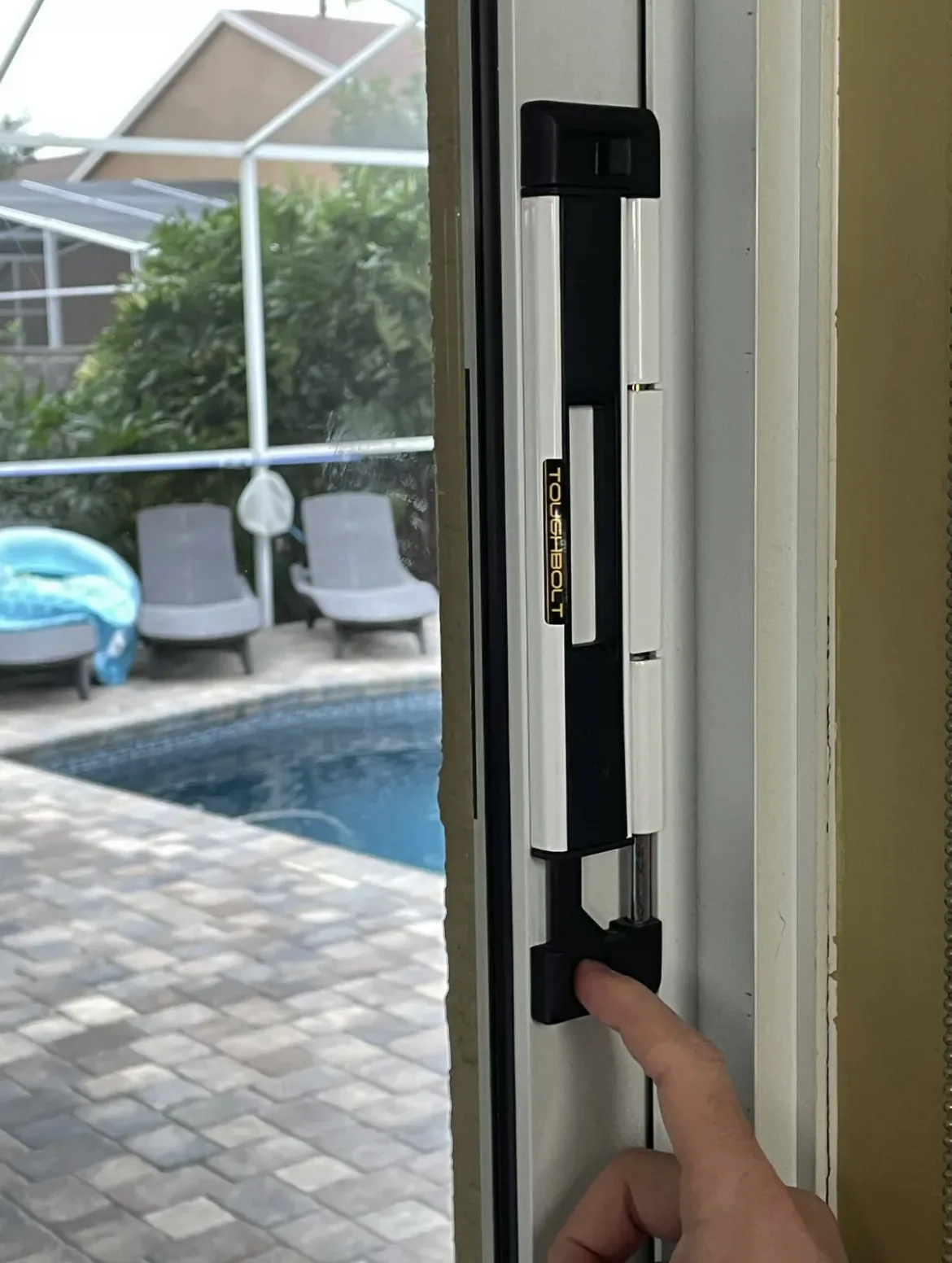
Precise alignment is everything on a sliding door lock. Our technicians install every unit so it seats, throws, and releases exactly as designed.
Locks live in the same salt air as the rest of the door. Routine check-ups and prompt repairs keep yours turning smoothly for the long haul.
From secondary locks to modern security hardware, we tailor upgrades to your property, your habits, and your peace of mind.
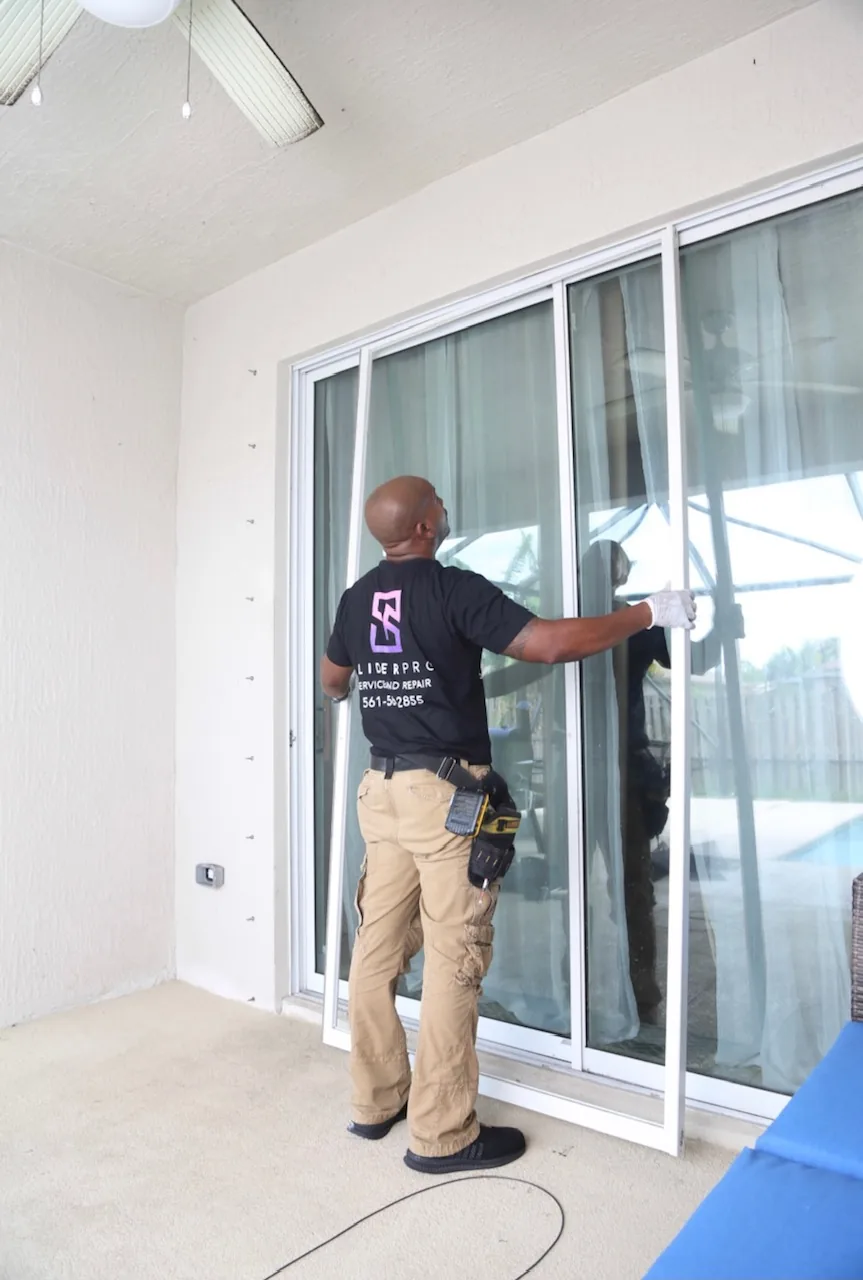
A sliding door lock is only as good as the door it's mounted on. Because we service rollers, tracks, and alignment every day, we fix the sag and drift that make locks fail in the first place — then fit hardware that holds. Premium products, transparent communication, and fair pricing, from a team with extensive Treasure Coast experience.
Secure My DoorsThe factory latch on most sliding doors is a convenience catch, not a security device — it can often be defeated with a firm lift or a flat tool. But the door itself isn't the weakness; the hardware is. A properly installed deadbolt-style lock anchors the panel to the frame and turns your slider from the easiest entry in the house into one of the hardest.
We install robust deadbolt locks purpose-built for sliding doors and windows, chosen for durability and resistance to force. Where it makes sense we add secondary measures, and for customers who want more we design custom upgrades using current security technology.
Often, yes. Many 'broken' sliding door locks are really alignment problems — a door that has dropped on worn rollers no longer meets its keeper, so the latch can't catch. We service and repair existing locks, and because we're door specialists, we fix the alignment cause, not just the symptom.
Yes. We secure sliding doors and windows for homes, seasonal properties, and rentals across the Treasure Coast — anywhere a glass door is the weak point, we can harden it.
Four separate pieces of hardware get called "the lock" on a sliding glass door, and they fail in four different ways. Knowing which one you have is the difference between a ten-minute fix and a part that has to be matched.
When we quote a lock visit we name the piece. "The keeper is elongated and the lock body is fine" is a different job from "the casting has crumbled," and you should be told which one you have before anyone starts talking about hardware. See all seven repairs we run.
Most sliding door lock bodies are zinc castings with a steel spring and a steel latch inside. That combination gives four repairable failures and one that is not repairable, and we can usually tell them apart with the face plate off.
The one that cannot be saved is a cracked or crumbled casting. Zinc that has corroded through shows as white powder and a body that flexes or breaks apart in your hand. There is nothing to shim and nothing to re-tension, so the body is replaced.
And there is a point where we will tell you the honest answer is a new door rather than new hardware: when the stile has corroded through around the mortise pocket, when a previous repair has enlarged the cut-out so no body will sit square in it, or when the frame itself has failed at the sill. A lock needs sound metal to bolt to. If that metal is gone, fitting better hardware just moves the failure a few months down the road, and we would rather say so.
A slider is not made secure by one better lock. It is made secure by closing three separate attacks, and each one needs its own piece of hardware.
Layer one is the primary latch. This is the everyday lock in the panel edge. Its weakness is that it is a single point of engagement in the middle of a tall panel, so the panel can be flexed away from the jamb until a spring latch pops out of its keeper. A hook bolt fixes that by grabbing behind the keeper instead of resting in it.
Layer two is a second point of engagement. An auxiliary lock fitted high on the stile, well away from the primary latch, gives the panel two bites on the frame. Two widely spaced points are much harder to defeat than two points close together, because there is no longer a single place to flex.
Layer three is anti-lift. Every sliding panel hangs with vertical clearance in the head channel, because that clearance is how the panel was installed in the first place. Lift the panel into that gap and the rollers come clear of the sill, and the whole leaf can be walked out of the opening with both locks still thrown. A foot bolt pins the panel down. Anti-lift screws set into the head track close the gap to a few millimeters so there is no room to lift at all.
A track blocker is the fourth thing people ask about, and it is the weakest of the four: it stops the panel sliding, but it does nothing about the lift-out. Our full sliding door security guide walks all six layers in order.
Every repair company in Florida will tell you salt air is hard on hardware. Almost none of them will tell you what salt air actually does, so here is the mechanism.
Onshore wind picks up seawater as aerosol: droplets small enough to stay airborne for miles. They land on everything, the water evaporates, and a film of chloride salt is left behind on the metal. That film is the problem, because chloride is hygroscopic. Around 75% relative humidity it stops being a dry crust and pulls enough moisture out of the air to go liquid again. On the Treasure Coast overnight humidity clears that figure most of the year, which means the salt film on your lock is a thin brine for hours a day, every day, even when it has not rained in a week.
Brine does two things inside a mortise pocket, and a mortise pocket is the worst possible place for it: a sheltered cavity that rain never rinses and airflow never dries.
First, chloride breaks down the protective oxide layer on steel, so the spring and the latch pit rather than rusting evenly. Pitting is why a lock can look clean on the face plate and be seized solid inside.
Second, brine is an electrolyte, so dissimilar metals bolted together start behaving like a battery. The aluminum stile and the zinc lock body are both less noble than the steel fasteners and springs running through them, so they give up metal first. The white bloom you see around old lock screws is that reaction, and it is what actually jams the mechanism: corrosion product takes up considerably more room than the metal it came from, so it swells inside a pocket machined to a few thousandths of clearance.
This is also why the gradient is so steep. A door within a few blocks of open water collects far more deposit than the same door two miles inland, and the ocean-facing side of a house collects more than the sheltered side. It is the same chemistry behind doors that stick in coastal Florida.
A lock is usually thought of as a security device. In a wind event it is also structure.
Wind on a large glass panel is a pressure load, positive on the windward face and suction on the leeward one, and it cycles rather than pushing steadily. The panel resists that load at a handful of discrete points: the interlock stile where it meets the fixed panel, the rollers on the sill, the head channel, and wherever the lock engages. A latch that only just catches, or a hook bolt engaging half its depth because the panel has dropped, removes one of those points. The panel then flexes and rattles under pressure cycling, and on a bad night the interlock can walk out of engagement entirely.
Foot bolts matter here more than most people realize. On a three or four panel door, the secondary panels are often held by nothing but a bolt at the head and one at the sill. Those bolts are the things nobody has operated in years, so they are painted over, corroded down or missing, and the panel that is supposed to be pinned is just sitting there.
Before the season starts, throw every lock and every foot bolt on every slider in the house and confirm each one seats fully. If one does not, that is worth a call now rather than in June. Our hurricane prep checklist covers the rest of the door.
The slider that opens onto the pool deck almost always fails before any other door on the same house, and it is worth knowing why before you assume you got a bad lock.
Pool water carries chlorine or, with a salt generator, dissolved chloride. Both leave the water as vapor, both condense on the coolest nearby metal, and the nearest cool metal is usually the door hardware six feet away. Add wet hands, sunscreen residue and the grit that gets tracked over from the deck, and the mortise pocket on a pool slider collects a paste that no other door in the house sees. On a screened lanai it is worse again, because the screen cuts the rain that would otherwise rinse the face plate.
Three things to check on a pool-facing door: whether the latch still returns crisply under its own spring, whether the foot bolt still drops all the way into its sill hole rather than stopping short on packed debris, and whether the keeper screws are still tight in the frame.
There is a separate question we deliberately do not answer for you. In Florida, a door with direct access to a pool can be treated as part of the pool barrier, and there is more than one approved way to satisfy that. Which option applies to your house depends on the property and the code in force, and that is a building department question rather than a lock question. Get that answer from your county, not from a repair company.
On a balcony slider, one door is often owned by two parties, and the split is the first thing to establish before anyone drills into a frame.
In most Florida condominium documents, the operating hardware on the inside of the unit is the owner's responsibility: the lock body, the latch, the keeper, the handle and the rollers. The frame, the exterior finish and anything visible from outside the building is more often the association's, because it is part of the building envelope and its appearance. That is the common pattern, not a rule. The declaration decides, and the declaration is a document, not an opinion from whoever answers the phone in the office.
The practical consequences are simple:
Ask for the section of the declaration that defines unit boundaries and the section on alterations, and ask in writing. Ten minutes of reading in advance is what stops an owner paying twice. We walk the whole split in who pays for a condo balcony slider.
A closed-up house is the hardest six months a sliding door lock ever does, and the damage is done by the closing up rather than by the heat.
Here is the sequence. You set the thermostat high or turn it off, so indoor humidity climbs and stays there. The mortise pocket, which never dries out properly at the best of times, now stays damp for months. And because nobody is home, nobody operates the lock. That last part matters more than people expect: a lock worked several times a day wipes its own sliding surfaces clean every time it moves. A lock thrown once in May and left is a set of steel faces sitting motionless in a humid pocket, and corrosion product builds undisturbed on exactly the surfaces that have to slide.
In November the key turns and the bolt does not move, or the latch will not retract at all. The lock did not break while you were away. It welded itself shut.
What actually helps:
A close-up and open-up visit covers every slider in the house at once, which is usually cheaper than one emergency call in season. Owners renting the property out will want the rental door checklist as well.
You can predict most of what is wrong with a sliding door lock from the year the house was built. Three eras cover almost every door on the Treasure Coast.
1970s and early 1980s aluminum. Thin-wall extrusions, light panels, small lock bodies, and face plate hole spacing that no longer matches anything on a shelf. The original pot-metal casting has usually crumbled by now, and the screw bosses in the thin stile are often stripped from previous attempts. These doors are very repairable, but they need a body matched to the existing mortise footprint. Enlarging the cut-out to fit a modern lock is how a repairable door becomes a replacement door.
Boom-era builds, roughly 1998 to 2006. Heavier panels than the 1970s doors, hardware specified on price. The lock is typically a plain spring latch into a stamped steel keeper. The important thing about this era is age: these doors are now twenty to twenty-five years old and a great many are still on their original rollers. The panel has dropped a few millimeters, the latch no longer meets the keeper, and the lock gets blamed for a roller problem.
Post-2005 impact doors. Laminated glass makes these panels dramatically heavier, and the stiles are thicker to carry it. Some use multi-point hardware, where one handle drives bolts at the top and bottom through a linkage rod. They fail differently: the rod or the drive gear goes rather than the latch, and because of the weight, any alignment shift shows up at the lock before you feel it in the slide.
We service the hardware on all three. Bring us the door you have.
We diagnose before we price, because on a sliding door the lock is the symptom at least as often as it is the fault.
Four checks, in this order: is the panel still at its designed ride height, does the latch actually present itself to the keeper, is the lock body jammed or genuinely broken, and will the stile still hold a fastener. You get told which of those it is, in plain words, before anyone talks about hardware. If the answer is that your rollers need doing and the lock is fine, that is what we will tell you, even though it is the smaller sale.
Repairs start at $275, and that figure includes parts, labor and a written 1 to 3 year warranty covering both. What moves it from there is straightforward: how many doors, whether the panel has to come out, whether the lock body is a stock pattern or has to be matched to an obsolete footprint, and whether the door needs rollers first for new hardware to be worth fitting.
Same-day service is available, and 96% of our jobs are finished in a single visit. In five years we have repaired over 1,600 doors across the Treasure Coast, and we have a 5.0 rating from more than 170 Google reviews, a Best of 2026 BusinessRate award and a steady stream of Nextdoor recommendations to show for it. If you want the wider picture on pricing, the Florida repair cost guide breaks down what drives every job on the truck.
We are based in Port St. Lucie and run lock work across the Treasure Coast and into northern Palm Beach County. What we find changes noticeably with the address.
We also cover Palm City, Hobe Sound, Port Salerno, Vero Beach, Jupiter and Palm Beach Gardens. The full list, with what each area does to a door, is on the service areas page.
Call 772-722-4036 for the Treasure Coast or 561-566-2855 for Jupiter and Palm Beach Gardens, or send us the details and tell us what the door is doing.
Free security consultation for your sliding doors and windows — honest recommendations, no scare tactics.