In today’s eco-conscious world, energy efficiency is a key consideration for homeowners looking to reduce their environmental footprint while saving on utility costs. One often overlooked area where improvements can be made is in the design and functionality of sliding doors. Upgrading your sliding doors not only enhances the aesthetic appeal of your home but also plays a significant role in keeping your indoor environment comfortable and energy-efficient. In this post, we will explore the benefits of upgrading your sliding doors, the features to consider, and how professional services like SliderPro Doors and Window Service can help you make the most of your investment.
The Importance of Energy Efficiency
Energy efficiency in a home is about maximizing the performance of your heating and cooling systems by reducing unnecessary energy loss. In many homes, sliding doors represent a substantial source of heat gain or loss. Gaps in insulation, poor sealing, and outdated glass can all contribute to energy inefficiencies that force your HVAC systems to work harder. Over time, these inefficiencies lead to higher energy bills and an increased carbon footprint.
By upgrading your sliding doors, you can improve insulation, reduce drafts, and create a more stable indoor climate. This means not only lower utility bills but also a reduced impact on the environment. In addition, a well-insulated door adds to the overall comfort and security of your home.
Key Features to Look For
When considering an upgrade to your sliding doors, it’s important to focus on features that enhance energy efficiency. Here are some key aspects to consider:
1. Advanced Glazing Options
Modern sliding doors are available with double or even triple glazing, which creates a barrier that minimizes heat transfer. Look for doors equipped with low-emissivity (Low-E) glass. Low-E coatings help reflect unwanted heat during summer months while keeping the warmth inside during the winter. This advanced glazing not only improves energy efficiency but also reduces glare and protects your interiors from harmful UV rays.
2. Improved Sealing and Insulation
Proper sealing is essential to prevent drafts and maintain a consistent indoor temperature. Upgraded sliding doors typically feature enhanced weatherstripping and insulated frames. These components work together to create a tight seal, significantly reducing air leaks. A well-sealed door ensures that your home stays warm during chilly winters and cool during the summer, contributing to a more comfortable living environment and lower energy consumption.
3. Durable and Energy-Efficient Materials
The material of your sliding door plays a crucial role in its energy efficiency. Doors constructed from uPVC, fiberglass, or thermally broken aluminum offer superior insulation compared to traditional materials. These modern materials not only resist weather-related wear and tear but also provide better thermal performance, ensuring that your sliding door contributes positively to your home’s overall energy profile.
4. Proper Installation
Even the best-designed sliding door can underperform if it isn’t installed correctly. Professional installation ensures that your door is properly aligned, sealed, and secured within the frame. This is critical for maximizing the energy-saving benefits of your new sliding door. A professional installer will also check for any potential issues that could lead to energy loss, such as gaps or misalignments, and address them promptly.
The Process of Upgrading Your Sliding Doors
Upgrading your sliding doors for energy efficiency typically involves a few key steps. Here’s what you can expect during the process:
Step 1: Assessment and Consultation
The first step is a thorough assessment of your current sliding doors. During this consultation, experts from SliderPro Doors and Window Service will evaluate your existing doors to identify areas where energy is being lost. This may include inspecting the glazing, seals, frames, and overall installation quality. Based on this assessment, you will receive recommendations on whether a retrofit or a complete replacement is the best option for your home.
Step 2: Selecting the Right Product
Once the assessment is complete, you can choose the best sliding door model that meets your energy efficiency needs. Whether you opt for double or triple glazing, advanced Low-E glass, or high-performance materials, the choice will be tailored to your home’s specific requirements. Professional guidance ensures that you select a door that not only looks great but also maximizes energy savings.
Step 3: Professional Installation
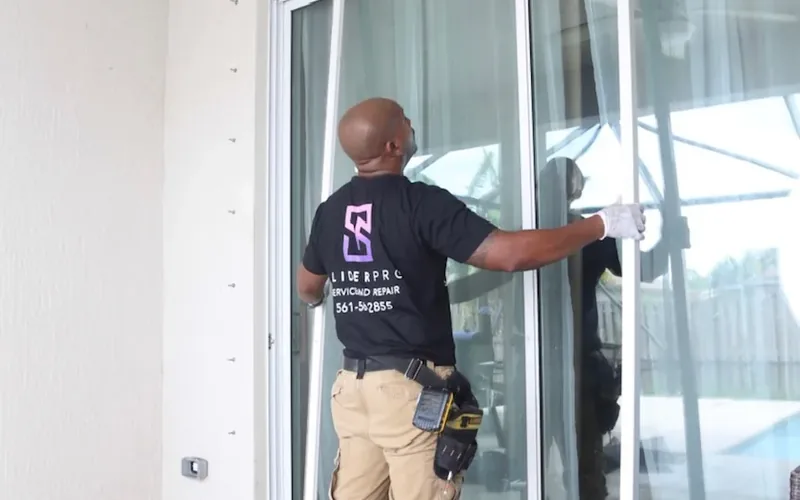
After selecting your new sliding door, the next step is professional installation. Expert technicians will handle all aspects of the installation, from removing the old door to ensuring that the new one is perfectly aligned and sealed. This meticulous process is crucial for achieving optimal energy efficiency. With precise installation, you can rest assured that your new door will perform as intended, reducing drafts and keeping your home comfortable year-round.
Step 4: Ongoing Maintenance
Upgrading your sliding door is not a one-time investment; it also requires ongoing care to maintain its energy-efficient performance. Regular maintenance, such as cleaning the tracks, lubricating the rollers, and inspecting the seals, will ensure that your door continues to function smoothly. SliderPro offers maintenance services to help you keep your sliding door in top condition, further extending its lifespan and enhancing its energy efficiency.
Benefits Beyond Energy Savings
While the primary goal of upgrading your sliding doors is to improve energy efficiency, there are several additional benefits to consider:
Enhanced Security: Newer sliding doors come with improved locking systems and stronger frames, offering better protection against intruders.
Aesthetic Appeal: Upgraded doors contribute to a modern and stylish appearance, enhancing the overall curb appeal of your home.
Increased Home Value: Energy-efficient upgrades are highly valued in the real estate market, potentially increasing the resale value of your property.
Environmental Impact: By reducing energy consumption, you contribute to a greener environment and help lower your household’s carbon footprint.
Why Choose SliderPro?
At SliderPro Doors and Window Service, we specialize in providing high-quality, energy-efficient sliding door solutions tailored to your needs. Our team of experts is committed to delivering superior products and services, ensuring that your home remains comfortable, secure, and energy-efficient. For more information, visit https://www.sliderpro.com/, call us at 772-722-4036, or get in touch via our contact page.
Conclusion
Upgrading your sliding doors for energy efficiency is a smart investment that pays off in multiple ways. From reducing your energy bills and enhancing your home’s comfort to improving security and boosting curb appeal, the benefits are clear. With advanced glazing, improved sealing, and high-quality materials, modern sliding doors offer a host of energy-saving features that can transform your home.
If you’re ready to take the next step toward a more energy-efficient home, consider consulting with the professionals at SliderPro Doors and Window Service. Our comprehensive assessment, expert recommendations, and precise installation will ensure that your new sliding door meets all your needs. Embrace the future of home efficiency and enjoy the long-term savings and benefits of a greener home.
Find the leak before you price a replacement
Everything above describes what a well-specified new door offers. This is the part most guides on this subject leave out: on the majority of uncomfortable Florida sliders, the glass is not the problem.
Air does not pass through glass. It passes around the panel, and there are only a handful of places it can go: the seal between the moving panel and the jamb, the sweep along the bottom, the interlock where two panels meet, the head channel, and the perimeter where the frame meets the wall. Every one of those is a repairable component on a door whose glass is perfectly sound.
The reason this matters financially is obvious once stated. Hardened weatherstrip and a misaligned panel are a fraction of the cost of a replacement door, and they are frequently the entire cause of the room that never gets comfortable. Replacing the glass while leaving a gap along the latch stile buys an expensive door with the same draft.
So the order is: find the leak, fix what is leaking, and then decide whether the glass is worth upgrading with a clear head. The next few sections are how you do that yourself, tonight, without buying anything.
Four ways a sliding door costs you money on the power bill
A slider affects a Florida cooling bill through four separate mechanisms, and they call for four different fixes. Confusing them is how people spend replacement money on a sealing problem.
- Air leakage. Conditioned air escaping and hot outside air entering around the panel. This is the one that responds to seals, sweeps and alignment, and on older doors it is usually the largest of the four. It is also the cheapest to fix by a wide margin.
- Solar heat gain. Sunlight passing through the glass and warming everything it lands on. This is the glass's job, addressed with low-E coatings, tint, films or exterior shade. It is worst on west-facing glass through the afternoon.
- Conduction. Heat moving through the glass and the frame itself. Double glazing and thermally broken frames address this. In a cooling-dominated climate it is real but smaller than the first two.
- Latent load. Humid outside air carrying moisture indoors, which your system then has to remove. This rides in on the same leak path as the first item and is the reason a leaky slider makes a room feel clammy as well as warm.
Note that two of the four are sealing and alignment. That is why the repair-first order is not a sales position, it is the sequence the physics recommends.
The five-minute leak test you can run tonight
You need a stick of incense or a lit candle blown out to a smoke stream, and about five minutes. Do it with the house closed up and the air conditioning running, so there is a pressure difference to reveal.
- Close and lock the door. Locking matters, because a latched panel is pulled tight against its seals and an unlatched one is not. If the door will not lock, stop here: that is your leak and it is an alignment fault.
- Run the smoke slowly down the latch stile, the vertical edge where the moving panel meets the jamb, from head to sill. Watch for the stream bending or breaking.
- Trace the interlock, the vertical joint where two panels overlap. This is the most commonly failed seal on any slider and the one people never think of.
- Run along the bottom sweep, then the head channel above.
- Finish around the outside of the frame, where it meets the wall. Movement here is a caulking or flashing issue, not a door issue.
Mark every point where the smoke moved. Then do the daylight version: at night, have someone shine a flashlight along the outside of the closed door while you watch from inside. Any light you can see is a gap you are paying to condition. Both tests take longer to read about than to perform, and either one will tell you whether glass was ever the issue.
Seals, sweeps and weatherstripping: the cheapest fix, and usually the one that matters
Weatherstrip on a sliding door is a consumable, and in Florida it is a short-lived one. Understanding why explains the smoke test result.
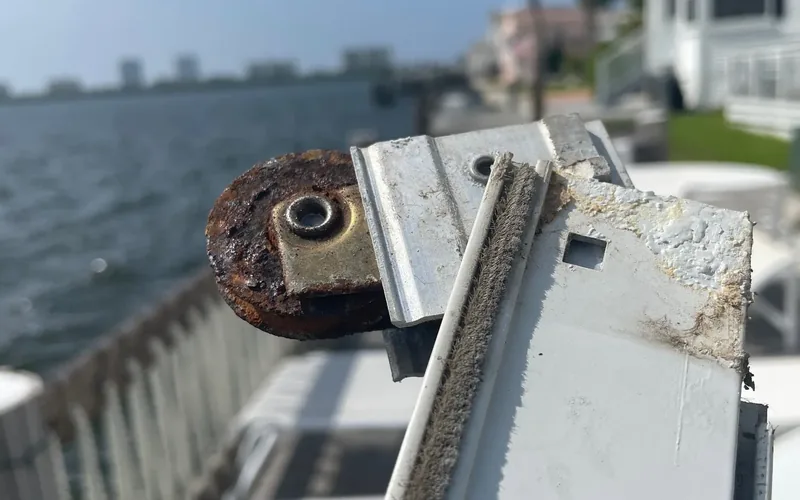
Most sliders seal with fin or pile weatherstrip. Fin seals are flexible strips that press against the adjacent surface; pile is dense brush set in a groove. Both work by staying springy. UV and heat are what end them: the polymer loses plasticizer, hardens, and takes a permanent set in whatever position it was last compressed into. A hardened fin no longer springs back to meet the panel, and flattened pile no longer bridges the gap. From two feet away it looks intact, which is why people replace glass instead.
Salt makes it worse in a way specific to the coast. The hygroscopic salt film holds moisture and grit in the pile, and the abrasion cuts fibers every time the door passes.
The test is tactile, not visual. Press the fin with a fingernail and let go. If it springs back, it is alive. If it stays where you put it, it is finished. Do the same on the bottom sweep, which is the hardest working seal on the door and the one that also keeps insects and driven rain out.
Replacing weatherstrip and a sweep is among the cheapest work done on a sliding door, and on an older slider it commonly closes most of what the smoke test found.
Why alignment is an energy problem too
Here is the connection nobody makes: a door that has dropped out of square cannot seal, no matter how new its weatherstrip is.
The mechanism runs backward from what people assume. As rollers wear, the panel settles a few millimeters, and it settles unevenly because the two roller assemblies rarely fail at exactly the same rate. The panel is now marginally out of parallel with the jamb it is supposed to seal against. At the top it may still touch; at the bottom there is a wedge of daylight. Weatherstrip is designed to close a consistent small gap, not a tapering one.
The tell you already know is the lock. A latch that misses its keeper, or only engages if you lean on the door, is announcing that the panel has dropped. If your door needs a shove to lock, it has not sealed properly in months. The full mechanics are here.
You can see it yourself. Close the door and look along the vertical gap at the latch stile, top to bottom. It should be even. A gap wider at one end is a sag, and the fix is at the rollers rather than at the seal.
This is why we treat a comfort complaint as a hardware inspection. Restoring the panel to square frequently fixes the draft, the lock and the drag in the same visit.
Track drainage, humidity and the moisture load nobody counts
Cooling a Florida house is as much about removing moisture as removing heat, and a sliding door contributes to the moisture side in ways that never appear in a glass brochure.
Weep holes are the small drains at the bottom of the outer track, designed to send water that gets past the outer panel back outdoors. They block with sand, leaf litter and the chalky residue of evaporated salt water. Once blocked, the track holds standing water after every rain. That is a shallow reservoir sitting inside your door, evaporating into the house through whatever gaps the smoke test found, and adding directly to the latent load your air conditioning must handle.
It also does slower damage. Standing water in an aluminum track keeps the salt film permanently wet, which accelerates the corrosion of everything sitting in it, including the roller bearings above it.
Clearing weep holes is a five-minute job with a soft pick and a rinse, and it belongs in the same routine as monthly track cleaning. Check them with a cup of water poured into the outer track: it should drain away, not sit.
If your door leaves a damp smell, a white crust, or a room that feels clammy rather than merely warm, look at drainage before you look at glazing.
The honest comparison: what repair fixes and what only replacement fixes
We repair doors, so here is the version with our own limits stated.
Repair genuinely fixes:
- Air leakage around the panel, through new weatherstrip, sweeps and interlock seals.
- The alignment fault that made sealing impossible, by restoring the panel to square.
- Moisture load from standing water, by clearing drainage.
- The draft under a door that no longer latches properly.
- Screen performance, including shade fabrics that reduce heat reaching the glass.
Only replacement changes:
- The glazing itself. Single-pane glass stays single-pane; no repair adds a low-E coating or a second pane. Film is a partial and separate measure.
- Thermal performance of the frame. An aluminum frame without a thermal break stays that way.
- Anything requiring an impact approval the current assembly does not carry.
- A frame that has corroded through or racked out of square with the structure.
Read those lists against your smoke test. If everything you marked is in the first list, repair is not the cheap compromise, it is the correct fix. If your discomfort is glare and radiant heat from an unshaded west-facing wall of single-pane glass with a sound frame and good seals, that is a glazing problem, and no amount of hardware work will touch it.
How to tell when a door is genuinely past repair, and what a new one realistically changes
Some doors are finished, and it does nobody any good to pretend otherwise. The markers are structural rather than operational: a frame that is bent, split or corroded through rather than merely stained; a threshold or opening that has settled so the door is no longer square to the structure; water entering through the envelope rather than through blocked weep holes; or multiple failed panes on a door that also needs everything else at once. Hold a straight edge along the frame and sight it. Frames that read straight are worth keeping.
If you are replacing, be clear-eyed about what changes. A new door with low-E glass will reduce the radiant heat coming through the glass and will seal properly on day one. Those are real improvements you will feel, particularly on west-facing glass.
What it will not do is fix a house. A slider is one component among the roof, the attic insulation, the duct work and every other opening, and its share of your bill is a share. We will not print a savings percentage or a payback period, because the honest range depends on your house, your glass area, your orientation and your habits, and any single figure quoted to you without that information was invented for the brochure.
The reasonable expectation is a more comfortable room and a door that seals. Treat anything more specific with suspicion.
Keeping the efficiency you paid for: seasonal homes, salt film and annual maintenance
Seals fail gradually, so nobody notices the day the door stopped sealing. Two habits keep it from creeping back.
Clean the track and check the drainage monthly. Vacuum, brush and wipe, then pour a cup of water into the outer track and confirm it drains. Grit in the pile weatherstrip is what abrades it; standing water is what keeps the salt film permanently wet against metal.
Do the fingernail test on the weatherstrip once a year. Press it and see whether it springs back. Do the smoke test at the same time. Five minutes annually catches a seal at the point where it is a cheap replacement rather than a season of high bills.
Seasonal homes need a different rhythm. A door that sits closed for six months corrodes faster than one in daily use, because motion is what wipes the salt film off the bearing surfaces. Weatherstrip compressed for half a year under a latched panel also takes a permanent set. Before you close the house, clean the tracks and leave the doors closed but not latched under tension. On arrival, run the smoke test before you form an opinion about the air conditioning.
If the test shows leaks or the door has become heavy, tell us what you found. Same-day appointments are available, and it is a great deal easier to fix a seal than to argue with a power bill.